Taking a page from roc’s book
17cb212dfcd0e69bc28e9fec652acfa4
Posted on February 4th, 2013 by Josh Matthews
Filed under: community, mozilla, Uncategorized | 5 Comments »
17cb212dfcd0e69bc28e9fec652acfa4
Posted on February 4th, 2013 by Josh Matthews
Filed under: community, mozilla, Uncategorized | 5 Comments »
Bugs Ahoy is coasting along right now, and that’s fine. It fills a need, and apparently it does that pretty well from what I hear. However, there is a greater need – Mozilla needs a task board for all activities, and we need to not be distracted by reinventing yet another system. I’m kicking off a project to expand the Bugs Ahoy project to fill this need, and I am need lots of help.
Here’s the plan:
The main work that needs to be done falls into two categories:
We want to avoid any need for users of the task board (both task creators and browsers) to ever visit Github; it’s just serving as a convenient backend to store the data. I’m snowed under with too many projects right now and can’t focus on this right now, but I would be thrilled to work with someone (or several someones!) to get it done. This is going to be a very useful tool when it’s finished, we just need some elbow grease to crank out a prototype. If you have experience with Javascript and/or Python, please get in touch! You can find the source on github.
Posted on December 12th, 2012 by Josh Matthews
Filed under: mozilla, projects | 2 Comments »
One thing that has become clear in my work as a Firefox coding steward is that we have no idea how healthy our community is. When people ask me how many unpaid contributors we have, I don’t have an answer I can give them. The corollary to this is that any attempts to change our contributor engagement processes will be complete shots in the dark, with us fumbling to discover what kind of effect our changes cause. David Eaves underlined this message in the community building workshop yesterday, so I decided to do something about it.
Measuring the size of a whole community is hard, so I’m not tackling that problem yet. Instead, I’ve focused on the problem of making first-time contributions more visible, and measuring the rate of incoming new contributors in a methodical way. I decided to extract the commit data of mozilla-central into a database which I could query in useful ways; in particular I store a table of committers that includes a name, email address, number of commits, date of first commit, and date of last commit. You can see the raw results of my work at my github repository, where I’m banging away at multiple tools that use this data in different ways.
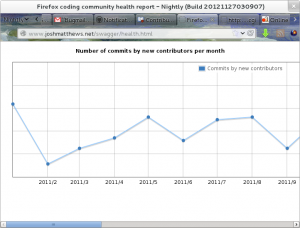
Tool the first – the Firefox coding community health report:
This measures the number of first patches that are committed in any given month. This graph allows us to see how effective we are at shepherding new contributors through the process of shipping their first change to the code.
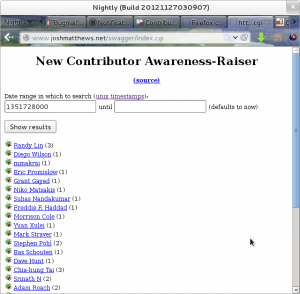
Tool the second – the first-time contributor awareness raiser:
This tool lists the contributors whose first patch was committed in a given period of time. With this, we can create reports that will allow us to take actions that celebrate this accomplishment (blog posts, swag, announcements in meetings, submissions for about:credits, etc.). This will allow us to take the burden of these tasks off of the engineers who can’t see beyond the patch, and place it in the hands of people who have a broader vision of building community effectively.
I’m not finished yet! I’m also really interested in measuring how many contributors drop off in a given month – by combining this with the incoming contributor data, we can get rough data about churn in the community, and compare how many people are leaving vs. how many newcomers we have. There are many more interesting measurements to be taken here, and I’m excited to be digging into this data. Feel free to join me! The github repo contains the script to create the database from the git mozilla-central repository, and you’re welcome to explore the data with me.
Posted on November 30th, 2012 by Josh Matthews
Filed under: community, mozilla, projects | 6 Comments »
Bugs Ahoy retrieves issues from Github for certain categories (such as B2G and Test Automation). Unfortunately, I learned recently that unauthenticated API users are now limited to 60 requests an hour, and that means that these categories often end up broken. I really want to fix this by being an authenticated user, but OAuth scares me. I would dearly appreciate someone fearless to help me get my github authentication ducks in a row so new contributors can see the full range of bugs available to them. Bugs Ahoy is entirely a client-side app written in HTML/CSS/JS, so bear that in mind when volunteering. Thanks in advance!
Posted on November 27th, 2012 by Josh Matthews
Filed under: helpwanted, mozilla, projects | 3 Comments »
Hello everyone, it’s your resident Private Browsing developer here! I’ll state it up front – the release of 15.0.1 was triggered by code I wrote that broke private browsing mode in significant, privacy-affecting ways. Ehsan and I fixed that for 15, 16, and 17 by backing out the problem code completely, but we’ve been working hard to fix it properly in Firefox 18 (currently in Nightly). This means that we want YOUR help to ensure that we haven’t subtly broken private browsing mode in nightly, and here’s how you can do that:
Take some time every day to clear your disk cache, then put your browser into private browsing mode. If you want to use it for traditionally-private things, that’s cool, it just may be slightly more embarrassing to thoroughly report bugs you encounter. What would be very helpful is if you could spend some time using your browser for regular, non-private things, and every so often open up about:cache and look through the entries in your disk cache. If you see any entry that looks like it came from one of the sites you were visiting, file a bug and CC :jdm and :ehsan. In fact, I will even accept comments on this post, or IRC pings, or emails, or whatever – these are important privacy failures that need to be addressed before FF 18 goes out the door. Do your part to make it unremarkable!
Posted on September 26th, 2012 by Josh Matthews
Filed under: mozilla, projects | 1 Comment »
Back in June I created the slightly-misnamed What Can I Do For Mozilla tool (misnamed since it only focuses on code that needs writing, ignoring any other useful skills). It took off all over twitter, but I never actually formally announced it. Now, whatcanidoformozilla.org needs your help! I want to fill it with as many projects and teams as I can, since I link an average of 250 people to it every month. Is your project missing from it? Find me and let me know, or (even better), file a pull request. The format for adding a new entry is really simple:
All I ask is that you link to a document that has some kind of instruction for how to get involved. That’s it!
Posted on August 9th, 2012 by Josh Matthews
Filed under: mozilla, projects | No Comments »
A mechanism that automatically expands all collapsed merges in a pushlog view. I don’t care if it’s a Firefox extension or modification to the pushloghtml source that adds an expand=1 parameter to the query string; I am tired of manually expanding each one.
Posted on April 15th, 2012 by Josh Matthews
Filed under: mozilla | 8 Comments »
I don’t always write code, but when I do… no wait, that’s not right. Here’s what I’ve been up to in the past week:
I sing in the an all-male university a capella group called The Water Boys. Our end of term concert is happening on Sunday, and the overall club EOT concert just occurred last weekend:
I also sing in a barbershop quartet called the Bearded Baritones, which doesn’t allow me to hide in the background nearly as much as the 17 person group does (third from right, if curious):
Having just attended my last class of my university career (assuming exams go well), I have to say that this is one aspect of the past five years that I will miss dearly when I move to Toronto this summer.
Posted on March 30th, 2012 by Josh Matthews
Filed under: personal | 1 Comment »
Do you get frustrated about how long it takes to build Firefox after you’ve only made a small change to a single file? Have you heard the words “incremental build”, or tried to only build one or two directories but can’t figure out why your changes aren’t showing up?
You are not alone.
I released my smartmake tool last year to allow people to specify then directories they’ve changed, and in return the tool would perform a correct incremental build. No hassle, no sweat. The name was deceptive; it was a pretty dumb tool, but it got the job done with a little help from the user. However, there is a rule that any build system tool eventually reimplements the functionality of make, and so I am proud to release smartmake v2, which requires less work than ever before to produce correct incremental builds.
Thanks to the hard work of the illustrious Till Schneidereit (till on IRC), smartmake now finds every source file modified since the last time you performed an incremental build, and performs a (mostly) minimal rebuild. It will also complain if it comes across any modified files for which it doesn’t have any dependency information, and suggest you perform a full build instead.
Go ahead, give it a shot! Tell me (or Till) what goes wrong so that we can fix it. I recommend doing a full build, then making a small change and running smartmake.py '5 minutes ago' to kick it off and get the timestamp caching happening.
Posted on January 24th, 2012 by Josh Matthews
Filed under: mozilla, projects | 4 Comments »
A contributor recently asked a question in #introduction that I couldn’t answer immediately, but I suspected that I could find the answer without too much work. I also decided to write down the steps I took and the reasons I took them, with the intent of creating a worked example of finding answers in the Firefox code.
The question: how do I determine if a given URI pointing to an RSS feed is subscribed as a live bookmark?
My first instinct when looking for code I have never touched before is to start with the visible strings in the Firefox interface. In this case, I went to slashdot.org and clicked on the RSS feed button to take me to the RSS feed viewer. Under the options for possible subscriptions, there is the “Live Bookmarks” choice. I’m going to find the code that handles subscribing a live bookmark, which should lead me to the way to find out if a feed is currently subscribed.
So, off to MXR: http://mxr.mozilla.org/mozilla-central/search?string=Live+Bookmarks&find=&findi=&filter=^[^\0]*%24&hitlimit=&tree=mozilla-central
Strings are usually stored in special localized files, where the actual string is referred to by a unique name. In this case, we’re looking at subscribe.properties, which shows us that some code should be using the name liveBookmarks to show the localized string in the feed viewer window.
Let’s look that up: http://mxr.mozilla.org/mozilla-central/search?string=livebookmarks&find=&findi=&filter=^[^\0]*%24&hitlimit=&tree=mozilla-central
Out of the results, subscribe.xml sounds like something I want to read: http://mxr.mozilla.org/mozilla-central/source/browser/components/feeds/content/subscribe.xml#53
Unfortunately, that line turns out to be not very interesting. However, let’s see what we can find for liveBookmarksMenuItem, which sounds like it might be the item for the live bookmarks option in the dropdown: http://mxr.mozilla.org/mozilla-central/ident?i=liveBookmarksMenuItem
Let’s look at FeedWriter.js from the results: http://mxr.mozilla.org/mozilla-central/source/browser/components/feeds/src/FeedWriter.js
Woah, that’s a lot of code! Let’s take a step back – we care about the subscribing action right now. Going back to subscribe.xml (http://mxr.mozilla.org/mozilla-central/source/browser/components/feeds/content/subscribe.xml), notice that the button is called subscribeButton. That sounds really useful! Let’s look in feedwriter.js again for that (just a regular ctr+f operation): http://mxr.mozilla.org/mozilla-central/source/browser/components/feeds/src/FeedWriter.js#859
Now, let’s find the function subscribe (ctr+f for subscribe:, as that’s commonly how member functions are defined in the Firefox source): http://mxr.mozilla.org/mozilla-central/source/browser/components/feeds/src/FeedWriter.js#1241
Reading the source of subscribe(), we come to
http://mxr.mozilla.org/mozilla-central/ident?i=addToClientReader
We can see the definition of addToClientReader at http://mxr.mozilla.org/mozilla-central/source/browser/components/feeds/src/FeedConverter.js#390. Let’s look at what else is defined here – this seems to be implementing the nsIFeedResultService interface, so we can look up the nsIFeedResultService.idl file in MXR: http://mxr.mozilla.org/mozilla-central/source/browser/components/feeds/public/nsIFeedResultService.idl.
Unfortunately, the service seems to be dealing with actual feed contents, and it doesn’t look like there’s a direct function to help us – let’s step back and see how addToClientReader is implemented.
http://mxr.mozilla.org/mozilla-central/source/browser/components/feeds/src/FeedConverter.js#448 is an important line – let’s look at addLiveBookmark (I just clicked the name again): http://mxr.mozilla.org/mozilla-central/ident?i=addLiveBookmark
Take a look at http://mxr.mozilla.org/mozilla-central/source/browser/base/content/browser-places.js#457. This shows us how a bookmark dialog is created, but not the actual subscription process. However, the important part is line 471, which shows us the type "livemark". Let’s search for that string and see what other code uses it: http://mxr.mozilla.org/mozilla-central/search?string=livemark
Woah! There are a lot of results! Since I’m not certain what I’m looking for at this point, I find the best thing to do here is to scan all the results quickly, looking for interesting snippets or filenames before opening any particular file. Partway down, there’s a file called test_bug636917_isLivemark.js (http://mxr.mozilla.org/mozilla-central/source/toolkit/components/places/PlacesUtils.jsm
Searching for livemarks in this file, we find line 2234 which defines the livemarks object as the nsILivemarkService service. Let’s look that up!
First the idl definition, to see if this service will be useful: http://mxr.mozilla.org/mozilla-central/source/toolkit/components/places/nsILivemarkService.idl. There’s a method called getLivemarkIdForFeedURI (http://mxr.mozilla.org/mozilla-central/source/toolkit/components/places/nsILivemarkService.idl#107), which looks to be exactly what we want – it gives us a -1 result for a non-registered feed and another number for a registered one.
So, to sum up – we have found a service that will take a URI and return a value that can be used to determine whether a given feed is a subscribed livemark, and we have learned that livemarks are the internal name for Live Bookmarks. The only bit remaining now is to get access to this service, but we can either use PlacesUtils.livemarks for that (if we import PlacesUtils.jsm), or just use a normal getService call. These are just details; the hard part of answering the original question is complete!
Posted on January 12th, 2012 by Josh Matthews
Filed under: mozilla | No Comments »